

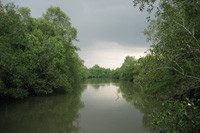
 Located in the Northeast part of Singapore nearby the Kranji Reservoir, Sungei Buloh Wetland Reserve is preserved as a wetland site and consequently designated as a nature park. Originally 87 hectares when it opened in December 1993 and now extended to 130 hectares, the Park received international status as a site for migratory birds in 2002.
Funding sources and management structure
The costs of construction and operation of the Reserve is mainly supported by the Singapore Government. In 1997, Sungei Buloh Education Fund was set up to support outreach programmes at the Reserve and SG120,000 was donated by HSBC Care as a start-up fund. The Reserve is managed by the National Parks Board (NParks), a statutory board in the Ministry of National Development.
Managing sustainability
NParks is part of the government, so the decision making process is centralized. Sungei Buloh Master Plan was launched in 2008 to develop the existing Kranji Nature Trail into Sugei Buloh Wetland Park.
Benefits to the community
The Reserve offers research opportunities in ornithology and mangrove wetland wildlife, providing primary data and a study site for gathering first-hand researches on natural sciences. For others, the Reserve provides a form of recreation for people to appreciate nature and wildlife.
 The London Wetland Centre, located in Barn Elms, southwest London, is a wetland conservation partnership between the Wildfowl and Wetlands Trust (WWT), Thames Water and the Berkeley Group. The land was originally owned by Thames Water. The Berkeley Group purchased part of the site for development; some of the income generated was donated to the WWT for the construction of the centre.
 Managed by the World Wide Fund for Nature Hong Kong, Mai Po Nature Reserve occupies 380 hectares in the heart of Hong Kong’s only internationally designated wetland. The site is known to support 16 globally threatened species of birds, over 20 species of invertebrates new to science and one crab species endemic to the Pearl River Delta.